Overclocking
What You Actually Risk, Stated Plainly
The damage that matters most does not announce itself. It accumulates, and it looks like an unrelated problem six months on.
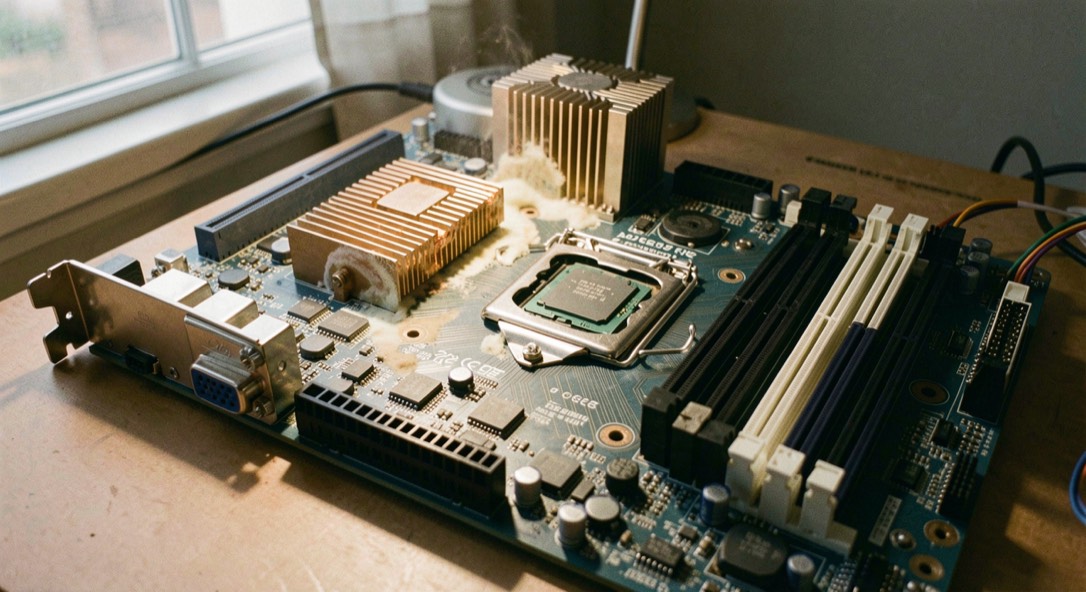
A part run past its rated clock rarely dies loudly. The documented failure path is quieter: metal slowly relocating inside the chip, glitches arriving long before anything stops working, and symptoms blamed on software because nothing on a bench can watch an atom move.
The number on the box is a binning decision
Parts from one manufacturing process are tested after production to establish their actual maximums, then marked with a rating chosen by the market needs of the maker. When the yield is good, more high-grade parts come off the line than the top bin needs, and the surplus is sold as lower-rated stock. In some cases a part's true maximum exceeds even the highest rating its maker sells; in the worst case, running at that higher rating is more problematic. Bob Colwell, the Pentium architect, called overclocking "an uncontrolled experiment in better-than-worst-case system operation".
So what actually wears out?
Heat is the usual answer and it is incomplete. A higher clock always means more waste heat, frequency raises thermal output roughly in line, and voltage raises it quadratically. But heat is the accelerant, not the damage. The damage is transport: conducting electrons hand momentum to metal atoms, and over time a significant number are knocked far from their positions. In a narrow interconnect that traffic opens a gap, a void, an open circuit. Where atoms pile up and drift toward a neighboring conductor instead, the result is a hillock or whisker, a short. Neither fault is visible from outside the package; in a laboratory, an electron microscope shows the erosion plainly.
Two structures, two very different thresholds
The same physics does not bite everywhere at the same intensity. In copper or aluminum interconnects, electromigration appears at current densities of roughly one to ten million amperes per square centimeter. In the solder joints that carry current between a chip and its board, it appears near ten thousand, about two orders of magnitude lower, which is why a joint can fail while the line it feeds looks untouched.
| Structure | Typical current density | Failure it produces |
|---|---|---|
| Copper or aluminum interconnect | 1,000,000 to 10,000,000 A/cm² | Voids open in the line, or atoms pile into a hillock that shorts a neighbor |
| Solder joint, SnPb or lead-free SnAgCu | Around 10,000 A/cm² | Atoms accumulate at the anode, voids open at the cathode, first at the corners |
Where the effect lands is not random either. A localized spike in current density, current crowding, decides where voids open first, and in a solder joint that means the corners. Field failures are documented: in the late 1980s, one line of Western Digital desktop drives failed predictably after twelve to eighteen months of use, and forensic analysis of returned units traced the fault to improper design rules in a third-party supplier's controller IC.
What does a lifetime equation actually promise?
Because real-world testing is too slow to wait for, the industry predicts lifetime instead of measuring it. Black's equation, developed by Jim Black of Motorola in the late 1960s, estimates a wire's mean time to failure from current density and temperature, after the part has been put through high-temperature operating life (HTOL) testing. Temperature sits in the exponent, so it weighs the estimate heavily. The model's constants appear on the reference page as examples for a material system, not for any part you can buy, and the page itself notes that as interconnects shrink toward nanometer scale the equation's validity becomes increasingly questionable. The phenomenon, electromigration in metal interconnects, has been on record for over a century, and it became a crisis when the earliest packaged ICs failed within three weeks.
Then why did the stress test pass?
Because the first symptoms of this damage are intermittent glitches. As some interconnects fail before others, the circuit produces seemingly random errors that may be indistinguishable from other mechanisms, electrostatic discharge among them. Undetected errors also mean silent data corruption, which may never be correctly diagnosed and instead gets blamed on an application, a driver, or the operating system. Enthusiast practice says a long run settles the question; the record is more guarded. Overclockers claim testing can ensure stability, yet it is generally impossible for any private individual to thoroughly test the functionality of a processor. Some manufacturing techniques, silicon on insulator among them, produce devices with hysteresis, where past events shape present behavior, so the same sequence of state changes can work at identical voltage and temperature in one situation and fail in another. Such a system can sail through the run described in what a stress test proves, then trip over a different program. When an error does surface, reading an instability instead of guessing is the work left.
The margin the designer already spent
None of this makes every chip fragile. Nearly all IC design houses run automated tools that check and correct electromigration at the transistor layout level, and in modern consumer electronics, ICs rarely fail from the effect. The boundary is stated bluntly on the reference page: when operated within the manufacturer's specified temperature and voltage range, a properly designed IC is more likely to fail from other environmental causes. Inside that envelope the margin belongs to the designer; outside it, the budget is yours, and warranty language draws the same line, since many manufacturers do not cover overclocking damage while some allow it inside a predefined safety margin. The metal even recovers partly. Failure develops far more slowly under alternating current, a reverse current restores 70 to 90 percent in bidirectional pulse testing without ever finishing the job, and recovery runs faster and more complete at higher temperature, which the record states and nobody should read as advice.
The concrete move, if a machine that has lived above its rating starts misbehaving: return the part to its shipped configuration and try to reproduce the fault before accusing the operating system. A component damaged by overclocked use can misbehave even under normal operating conditions without becoming unusable, so the fault follows the part, not the settings. Thermal headroom sets how fast the damage accumulates; what counts as evidence is a decision, and it goes better made before the first glitch.
Before you push a part past its rating
- Decide in advance what counts as evidence of a fault, so an intermittent glitch reads as a change and not as noise.
- Read the warranty terms: many makers exclude overclocking damage outright, some allow it inside a predefined safety margin.
- Keep a way back to the shipped configuration, since a part degraded above its rating can misbehave even under normal operating conditions.
- Scope the test honestly: no private individual can thoroughly test a processor's functionality, and a system can pass a run and still fail in another program.
Where this goes wrong
Reading a clean run as a certificate. A pass says those patterns, at that speed and that temperature, on that day, produced no detected error. With hysteresis in the silicon, the same voltage and temperature can pass one sequence of state changes and fail another, so the certificate covers the sequence that ran and nothing else.
Accusing the software first. The earliest symptoms of electromigration damage are intermittent glitches that may be indistinguishable from other failure mechanisms, electrostatic discharge included, and silent data corruption may never be correctly diagnosed at all. Western Digital's engineers needed forensic analysis of returned drives to blame a supplier's controller; on one bench, attribution is harder, which is why the settings come off before the operating system takes the accusation.
The physics here comes from the Wikipedia article on electromigration. It defines the effect as the transport of material in a conductor caused by momentum transfer between conducting electrons and diffusing metal atoms, and it carries the history from Gerardin through Black's equation at Motorola, the failure mechanisms in interconnects and solder joints, design countermeasures from alloying to bamboo structures and Blech length, and partial healing under reverse current.