Overclocking
The Vocabulary of Overclocking
Most overclocking arguments are vocabulary arguments. Six terms carry almost all of the misunderstanding.
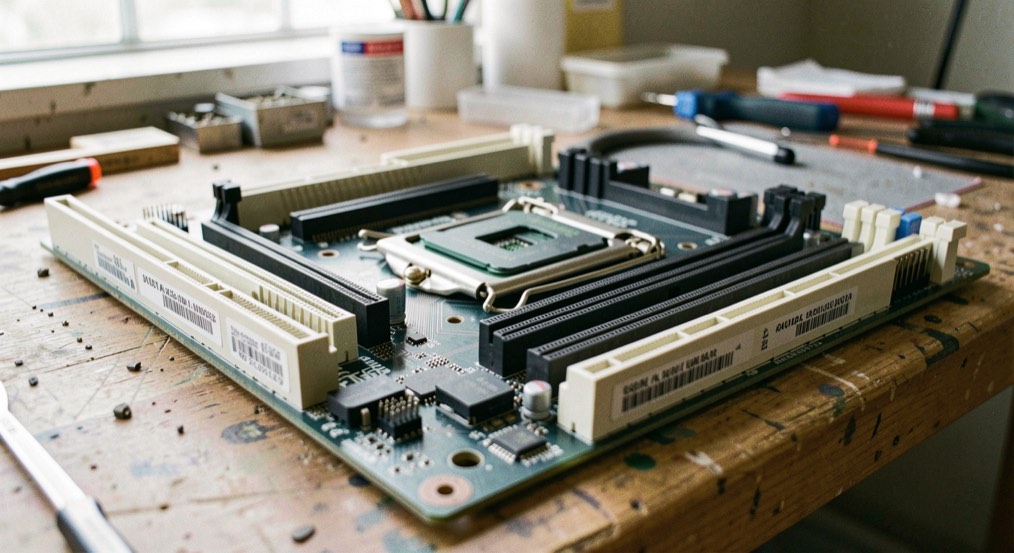
Most arguments about overclocking are vocabulary arguments in hardware clothes. One side says "stable" and means a night of load survived; the other hears a property of the machine. This page walks six words met in firmware screens, multiplier, base clock, voltage, offset, boost and limits, and marks what the reference defines, what it reports, and what it never says.
What does a rating promise?
The Wikipedia article on overclocking defines the practice in one clause: raising the clock rate of a semiconductor device beyond its rated speed, which can increase performance and might not. Everything hangs on "rated". Components from one process are tested after manufacture, then marked with a rating chosen for market reasons; when yield runs high, parts measured as higher rated are sold as lower rated, and a part's true ceiling can sit above the highest rating sold. That is what Pentium architect Bob Colwell names "an uncontrolled experiment in better-than-worst-case system operation", and it comes with one constant: more waste heat, always, because transistors held high dump to ground more often.
The multiplier, met as a lock
The reference meets the multiplier through conflict: manufacturers implement CPU multiplier locking to keep buyers from purchasing cheaper parts and clocking them up, a measure marketed as consumer protection and regularly criticized by the buyers it protects. Motherboards are sold and advertised with extensive overclocking facilities in hardware, controlled from BIOS settings. The word names both a lever and the fence around it. Two words from this page's set never appear in the article: base clock and offset. It speaks of clock rate and rated speed, and leaves the firmware nouns to the board manuals. A definition of either term attributed to this source would be invented.
Voltage pays by the square
Operating voltage enters the article in a supporting role: often raised to hold a part stable above its rating. The billing is where the word earns respect.
| Lever | Why it moves | How the bill scales |
|---|---|---|
| Clock rate | Performance, sometimes | Thermal output rises linearly |
| Operating voltage | Stability at the higher speed | Thermal power rises quadratically |
| Fan speed | Removing the added heat | Noise tracks roughly the fifth power of speed |
Two figures anchor the last row: fan noise can reach 50 dB or higher, and halving a fan's speed buys back about 15 dB. Behind all three rows sits a named failure mode, a part requesting more power than its supply can provide. What a board reports about its own rails is a separate skill, treated in voltage sensors, read properly.
Boost: a rating with a signature
Boost arrives pre-signed. The article files Intel Turbo Boost and AMD Turbo Core among processor power management technologies, beside dynamic frequency and voltage scaling: clocks the vendor moves, inside limits the vendor set. Factory overclocking extends the logic onto shelves: a manufacturer or retailer tests a part's overclocking capability and sells it pre-raised, with a warranty, between the standard product and a faster untouched one. Graphics cards get the same treatment, the GPU, its memory, or both. The vocabulary runs downhill: underclocking, defined as lowering the clock below default, trades performance for power, heat and fan noise, and doubles as a troubleshooting move.
Which limit arrives first?
Stock cooling is designed for non-overclocked heat and may be inadequate the moment the clock is not. Heat not removed is a listed cause of failure, and so is a supply already at its ceiling. Warranty draws a legal line, not a physical one: many manufacturers exclude overclocking damage, while some permit it inside a predefined safety margin.
Cold has its own limits. Liquid nitrogen, liquid helium and dry ice serve record attempts, not everyday systems: coolant reservoirs need refilling, condensation forms on chilled parts, and below roughly 100 K silicon JFETs degrade toward freeze out around 40 K. The silicon record it carries, above 500 GHz at 4.5 K under liquid helium, measured the rate a transistor can switch, not a CPU clock, a distinction the source itself insists on. The CPU frequency record it lists, 9,206.34 MHz in May 2026, is a record, not a setting.
Words to hold straight
- Clock rate and rated speed belong to the reference; base clock and offset belong to board manuals.
- A rating follows market needs after manufacture testing; it is not a measurement of the part in hand.
- Frequency bills linearly, voltage quadratically, fan noise by the fifth power of speed.
- A boost clock carries a vendor warranty position; a user clock is Colwell's uncontrolled experiment.
Is a clean pass a promise?
The article answers flatly: overclockers claim testing ensures stability, and it is generally impossible for a private individual to thoroughly test a processor's functionality. A 2011 field study it cites measured four to 20 times more crashes from CPU failure on overclocked consumer machines over eight months, depending on the CPU manufacturer. Damage can be partial, too: a pushed part misbehaving even back at normal conditions without dying outright. What a pass does cover is a narrower claim, kept narrow in what a stress test proves.
Where this goes wrong
The article's quietest warning concerns attribution: silent data corruption on an overclocked machine produces symptoms blamed on applications, drivers or the operating system, and the real cause is never diagnosed.
A pass can be honest and insufficient. Silicon on insulator devices carry hysteresis, past events conditioning present behavior, so one sequence of state changes holds at a given voltage and temperature while another fails under identical conditions. A part can clear a stress test and still fall over in a program the test never imitated.
Take one word off your own firmware screen tonight and hold it against the reference: multiplier, offset, boost. Sort it as defined, described, or absent, and carry that label into the next conversation. The bench glossary keeps the shelf; the label keeps the shelf honest.
The source behind these words
The overclocking article on en.wikipedia.org is the reference behind this page. It defines overclocking and underclocking, covers cooling from stock heatsinks to liquid helium, states the heat arithmetic, explains ratings as market decisions made after manufacture, and carries the frequency records, the 2011 crash study and Colwell's phrase. Terms it does not define are marked here as absent, not paraphrased.